- PHMSA proposes explicitly applying three independent shutoff devices to vapor-recovery openings on portable tanks carrying flammable refrigerated liquefied gases.
- The proposal preserves continued use of certain tanks built before January 1, 2029, and addresses composite service equipment within a limited port-area framework.
- Comments on HM-215S are due December 28, 2026; the proposed changes are not yet final requirements.
Portable tank rules would change in two distinct areas under a new federal proposal: the treatment of vapor-recovery openings on tanks carrying flammable refrigerated liquefied gases, and the limited movement of fiber-reinforced plastic tanks and service equipment through U.S. ports.
The Pipeline and Hazardous Materials Safety Administration published HM-215S, its proposed international harmonization rule, on October 27. The broader notice covers numerous hazardous-material classifications and packaging provisions. Its portable-tank changes deserve separate attention because they affect different equipment, activities, and purchasing decisions.
For tank owners, manufacturers, depots, and carriers, the immediate task is to identify which provision touches their operations. The valve proposal concerns a defined cryogenic-tank application. The composite provision addresses service equipment within an existing, restricted port framework. Neither should be treated as a general redesign instruction for every tank trailer or permission to deploy composite portable tanks throughout a domestic transportation network.


Which equipment the portable tank rules would affect
The valve amendment appears in 49 CFR 178.277(d)(1), governing service equipment on portable tanks used for flammable refrigerated liquefied gases. PHMSA would expressly include vapor-phase openings used for vapor recovery among the filling and discharge openings subject to the three-device requirement.
The separate amendment to Section 171.25(c)(5) concerns UN fiber-reinforced plastic, or FRP, portable tanks and service equipment under the International Maritime Dangerous Goods Code. It would add service equipment to the provision that restricts these movements to qualifying operations within a single port area.
These provisions are separate from the ASME construction and continued-service options PHMSA recently finalized. That distinction matters when an equipment discussion uses the broad term “tank”: the applicable specification and authorization determine which rule controls.
The proposed changes divide into three practical cases:
| Equipment or movement | Proposed treatment | Decision to review |
|---|---|---|
| Flammable refrigerated-gas portable tanks | Explicitly include vapor-recovery openings in the three-device shutoff requirement. | Review the vapor circuit and device arrangement with the manufacturer. |
| Affected cryogenic tanks constructed before January 1, 2029 | Allow continued use despite nonconformity with the proposed vapor-opening requirements. | Preserve construction records and confirm other applicable requirements. |
| UN FRP tanks and service equipment | Extend the existing single-port restriction and exception to service equipment. | Check the shipment’s authorization, trade connection, and complete route. |
The construction-date allowance belongs to the cryogenic valve proposal. It should not be transferred to the separate composite-equipment provision or treated as a general exemption for older equipment.
Vapor-recovery openings would be named explicitly.
The existing Section 178.277 service-equipment provisions already require at least three mutually independent shutoff devices in series at each filling and discharge opening on portable tanks carrying flammable refrigerated liquefied gases. PHMSA is proposing to clarify which openings that language includes.
The arrangement consists of a stop valve as close as reasonably practicable to the tank’s jacket, a second stop valve, and a blank flange or equivalent device. Describing this as a universal requirement for “three valves” would lose an important distinction: the third device can be a closure rather than another valve.
The device closest to the jacket must be self-closing and capable of closure within 30 seconds of actuation from an accessible position on the tank remote from the valve. It must also actuate at a temperature no higher than 121 degrees Celsius (250 degrees Fahrenheit). Those conditions already appear in the existing provision and are retained in the proposed text.

Valves, capped connections and instrumentation inside a cryogenic tank-container equipment compartment. (Photo: SinoCleansky)
The addition expressly covers vapor-phase openings used for vapor recovery. PHMSA explains that these openings are primarily used to precool tanks and reduce pressure during filling. For manufacturers and owners, that makes the vapor circuit a specific design-review item alongside the liquid filling and discharge connections.
The proposed construction-date allowance preserves continued use of certain older tanks; it does not remove their other safety obligations.The proposed regulatory text permits continued use of tanks constructed before January 1, 2029, that do not meet the vapor-opening requirements. That would limit the immediate retrofit implications for existing equipment. Buyers placing orders near the proposed cutoff should verify the final construction-date language and the manufacturer’s documented configuration before setting a delivery specification.
The amendment addresses the flammable refrigerated-gas paragraph. Section 178.277 treats nonflammable refrigerated gases separately, and its pressure-relief provisions serve another function. Equipment reviews must therefore identify the opening and its purpose before applying the proposed requirement.
Composite service equipment remains within a restricted port pathway
The composite provision starts from an existing limitation. Under 49 CFR 171.25(c)(5), UN FRP portable tanks that meet the referenced IMDG Code provisions are already restricted to transportation that satisfies the single-port criteria in paragraph (d). HM-215S would expressly add service equipment to that restriction and its exception.
PHMSA explains that this would allow FRP service equipment to accompany UN FRP portable tanks in qualifying port movements associated with international commerce. It does not propose broadly adopting the international FRP tank and service-equipment standards into the domestic Hazardous Materials Regulations.
The agency ties that position to research needs previously identified for FRP tanks: material fatigue, the suitability of pool-fire and impact tests, and appropriate nondestructive testing methods. The October proposal does not establish that those questions have been resolved. Instead, it preserves the limited transportation pathway while addressing the equipment it covers.

Eurotainer-branded OmniTAINER composite portable tanks illustrate the equipment category discussed in PHMSA’s proposal. (Photo: Omni Tanker/Eurotainer)
The underlying port provision has several conditions. It covers qualifying imports, exports, and shipments passing through the United States between foreign locations. Motor-vehicle movement must remain within a single port area, including contiguous harbors. Applicable IMDG packaging and hazard-communication provisions, U.S. shipping-paper and placarding requirements, and relevant vessel requirements still apply. Certain explosive divisions and radioactive materials are excluded.
A qualifying port movement and an inland delivery require separate authorization checks.Operationally, this means a route check before accepting the shipment. An ocean arrival and a short dray do not, by themselves, establish eligibility for the exception. If the planned destination is outside the qualifying port area, this provision alone does not authorize that inland leg. Terminal staff, dispatchers, and the receiving depot need the same understanding of where the permitted movement ends.
Tank Transport’s earlier coverage of composite portable-tank special-permit applications describes a separate authorization process. HM-215S should not be read as a decision on any individual application. An operator relying on a special permit must establish that the issued authorization covers its equipment and intended operation.
Purchasing and depot reviews should start with the records
For cryogenic equipment, a useful purchasing review would identify the tank specification, intended cargo, construction date, vapor-recovery connections, and closure arrangement. Manufacturers can then explain which features already meet the proposed language and which would require a design change. This is an equipment-planning exercise while the rule remains proposed.
Depots and maintenance providers have a related task: keep the proposed construction-date allowance separate from serviceability. The established portable-tank inspection and testing framework addresses unsafe conditions, damaged equipment, leaking components, and operation of closure devices. Continued use under a transition provision would not excuse a tank from those applicable duties.
For composite equipment, the review should document the relied-upon authorization, the cargo, the port movement, and any later inland leg. The same discipline applies to return movements and cleaning arrangements. As PHMSA’s separate chemical-tank and residue clarification illustrates, the tank’s contents and regulatory status remain relevant after unloading.
Owners and manufacturers can make comments more useful by supplying specific evidence: affected designs, engineering work, approval lead times, installation constraints, or examples of port movements that raise uncertainty. Statements about cost should identify the equipment and activity involved rather than assuming a fleetwide burden.
Comments are due December 28, 2026, under docket PHMSA-2025-0048, identified as HM-215S. The next consequential step will be PHMSA’s final language and implementation schedule. Until then, purchasing plans and operating procedures need to distinguish current authorizations from provisions still under consideration.
Portable Tank Rules: Key Developments
- Proposal: HM-215S was published October 27, 2026; comments are due December 28.
- Valves: PHMSA would explicitly include vapor-recovery openings in the three-device requirement for portable tanks carrying flammable refrigerated liquefied gases.
- Existing equipment: The proposed text allows continued use of tanks built before January 1, 2029, that do not conform to the vapor-opening requirements.
- Composites: The service-equipment amendment retains the single-port limitation; it does not create general domestic transportation authority.
- Planning: Verify the tank’s construction records, applicable authorization, service condition, and complete transportation route.
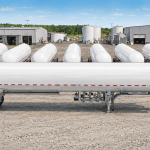
Featured photo: TeWeBs/Wikimedia Commons; CC BY-SA 4.0.