- Exosent’s Tank Truck Week showcase highlighted automatic tire inflation, connected tire monitoring, and wheel-end heat warnings.
- TireView LIVE gives fleet personnel access to equipment data, while Digital ThermALERT measures temperature near the wheel bearings.
- Equipment compatibility and a defined response to alerts remain central to putting the information to work.
Exosent Engineering’s LPG tanker monitoring showcase at Tank Truck Week brought together automatic tire inflation, remote tire data and wheel-end heat warnings, according to a September 28 announcement from Pressure Systems International (P.S.I.). The National Tank Truck Carriers event ran September 27–30, 2026, in Oklahoma City.
For carriers hauling liquefied petroleum gas (LPG), including propane, the practical issue is identifying tire and wheel-end problems while equipment is working. The systems address different parts of that task, from maintaining inflation pressure to giving drivers and maintenance personnel information about changing conditions.
Exosent’s 2026 typical trailer specification already lists P.S.I. automatic tire inflation with its tandem-axle suspension arrangement. It identifies the vessel as an MC 331 design for LPG service. Connected monitoring adds information around that existing equipment foundation.


Inflation and monitoring serve different jobs

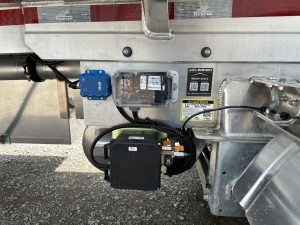
P.S.I. tire inflation hoses and TireView sensors on a trailer wheel. (Photo: Pressure Systems International)
An automatic tire inflation system (ATIS) supplies air to help maintain the trailer tires at a preset pressure. P.S.I.’s system routes air from the trailer reservoir through a control box and axle plumbing to the tires. A pressure-protection valve gives the braking system priority if the available air supply falls.
TireView is the tire pressure monitoring system (TPMS). P.S.I. describes an in-cab display that cycles through tire-pressure and temperature readings and warns about conditions outside selected limits. Monitoring provides information; the inflation hardware supplies air.
That distinction matters when fleets evaluate a specification. A trailer can have automatic inflation without giving the maintenance office a detailed history of each tire. Tank Transport’s earlier coverage of automatic tire inflation technology explains the role of preset pressure management.
The additional information can help a shop decide what to inspect, but a pressure reading alone does not identify every possible defect. Routine tire inspections remain necessary, along with checks of hoses, fittings, and the inflation system.
Digital ThermALERT tracks heat at the wheel end
Digital ThermALERT adds a separate measurement near the wheel bearings. P.S.I. says the sensor reads temperature inside the spindle end, providing information about the wheel end that is distinct from a tire-pressure or tire-temperature reading.
The technology predates this year’s show: P.S.I. introduced Digital ThermALERT in February 2023. The company says the data can help establish an equipment-specific operating-temperature baseline and identify conditions associated with dragging brakes or bearing problems. Alert levels can be customized.
P.S.I.’s TireView LIVE platform makes monitoring data available through its online portal or supported telematics integrations. Its documentation describes fleet dashboards, individual-vehicle views and historical reports, allowing maintenance personnel to examine readings beyond the driver’s immediate view.
The company specifies ATIS/MTIS equipment and TireView LIVE integration for Digital ThermALERT. Fleets therefore need to distinguish the inflation hardware, sensors, and communications service when reviewing a trailer order or retrofit proposal.
Fleets still need an alert-response plan

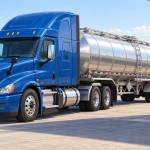
LPG tanker on U.S. Route 95 in Beatty, Nevada, in 2006. (Photo: Mark Holloway/Wikimedia Commons, CC BY 2.0; resized and compressed for web)
For LPG fleets, the operational question is who receives a warning and what happens next. A useful deployment assigns responsibility for reviewing alerts, contacting the driver, arranging inspection, and documenting the resulting repair. A dashboard has limited value if a developing problem has no clear owner.
The installed configuration also matters. P.S.I. documents TireView retrofit options, but a fleet should confirm the proposed sensors, wheel-end components, display, and telematics connection for its equipment. The manufacturer materials reviewed do not provide a full Exosent-specific price, subscription cost, or installation schedule for the connected package.
Existing inspection and maintenance duties continue to apply. Under 49 CFR 392.7, drivers must be satisfied that specified equipment, including tires, brakes, wheels and rims, is in good working order before driving. 49 CFR 396.3 requires the carrier to inspect, repair, and maintain equipment systematically. Monitoring data can support that work.
The Exosent showcase also follows Tank Transport’s coverage of Tremcar’s TremSmart technology preview, which brought tire monitoring together with cameras and weighing equipment for petroleum trailers. Each configuration needs to be evaluated on its own hardware, information access, and service requirements.
Exosent LPG Tanker Monitoring: Key Developments
- P.S.I.’s September 28 announcement highlighted ATIS, TireView LIVE and Digital ThermALERT on Exosent LPG trailers for Tank Truck Week.
- Exosent’s typical 2026 specification already includes P.S.I. automatic inflation; remote monitoring provides additional equipment information.
- Digital ThermALERT reports wheel-end temperature and requires hardware and telematics integration.
- Fleet-specific compatibility, alert handling, and costs need to be established before an order or retrofit.