- EV hazmat transport risks are now under federal review as PHMSA’s May 4 comment deadline puts tank fleets, propane carriers, and chemical haulers on the clock.
- PHMSA is asking whether battery-electric Class 8 trucks create new concerns for cargo tank stability, thermal runaway response, charging-site safety, and emergency documentation.
- The review could shape future research, guidance, and potential rulemaking on hazmat electric trucks, even though PHMSA has not yet proposed a new rule.
EV hazmat transport risks are no longer a hypothetical policy debate. As of May 4, 2026, the Pipeline and Hazardous Materials Safety Administration’s comment period on heavy-duty electric vehicles and hazardous-materials transportation closes today, with comments due on or before May 4. For more coverage of federal hazardous-materials oversight and agency activity, see PHMSA reporting.
The agency continues to emphasize that this is an information-gathering exercise, not a proposed rule.
That distinction matters. PHMSA is not yet creating a new mandate for electric hazmat transportation. It is asking whether the current rulebook, much of which was built around internal-combustion commercial vehicles, properly accounts for the operating characteristics of battery-electric heavy-duty trucks. For related updates on federal rulemaking, compliance, and transportation policy, follow Regulations coverage.
The docket is meant to build the factual record for future research and possible later action, not to impose an immediate new requirement.
“PHMSA is not asking whether EV trucks are cleaner. It is asking whether heavy-duty electric vehicles change the risk profile of hazardous-materials transportation.”
What has changed since PHMSA published the notice is not the legal status of the request, but the urgency of the deadline and the depth of the surrounding context. The comment window now closes today, making this a final-day opportunity for tank fleets, cargo tank builders, propane marketers, chemical haulers, insurers, emergency responders, and truck manufacturers to get operational concerns into the public record.
Since the notice was published, the federal backdrop has become clearer in three ways.
First, PHMSA’s own 2026 research agenda has aligned around safe energy storage, emergency-response risk reduction, efficient safety standards, and innovative packaging.
Second, post-2025 vehicle-documentation rules for electric vehicles now require standardized rescue sheets and emergency response guides for covered heavy vehicles.
Third, the main U.S. Class 8 battery-electric platforms have continued moving from pilot status toward commercial deployment. That makes the safety questions more concrete and less theoretical.
For tank fleets, cargo tank manufacturers, propane marketers, chemical haulers, insurers, and emergency responders, the issue is not whether electric trucks are cleaner than diesel trucks. The practical question is whether battery-electric trucks change the risk profile of hazmat transportation enough to require new guidance, new research, or eventual updates to federal hazardous-materials rules.
Why EV Hazmat Transport Risks Have Moved From Theory to Policy
The live federal question is narrower and more serious than whether electric trucks are coming.
The real issue is whether heavy-duty battery-electric trucks alter the hazard profile of transporting dangerous goods enough to warrant changes to hazmat rules, packaging assumptions, charging practices, or emergency protocols. For related coverage on hazardous-materials transportation, incident response, and compliance issues, browse the Hazmat archive.
On the official notice page and in the notice text, PHMSA says it wants input on packaging integrity, transportation safety, emergency response, regulatory compliance, and overall vehicle risk when comparing heavy-duty EVs with internal-combustion motor carriers.
The agency also says it may use the record to draft a statement of work for further research. That means the responses could influence what PHMSA studies next, even if no immediate rule follows.
That framing matters because it shifts the story from decarbonization rhetoric to operational evidence.
PHMSA is effectively asking carriers, builders, responders, and manufacturers to compare actual failure modes. That includes thermal runaway versus diesel fire behavior, charging-site hazards versus fueling-site hazards, battery mass versus diesel powertrain mass, and electric-system rescue procedures versus conventional post-crash procedures.
In other words, the government is not asking whether EVs are cleaner. It is asking whether they are sufficiently different in hazmat service to justify new controls, research, or both.
A second update is that PHMSA’s broader posture now looks more explicitly technology-modernization oriented. The March 2026 hazardous-materials research forum listed risk reduction for emergency response, safe energy storage technologies, efficient safety standards, and innovative packaging as priority themes.
In a separate agency newsletter, PHMSA also described a new data-driven inspection and enforcement framework for hazardous materials. Taken together, those updates suggest the EV notice is not an isolated one-off. It sits within a broader modernization effort focused on emerging transportation technologies.
From an industry perspective, that makes this a consequential early-stage proceeding.
A request for information does not determine the policy outcome. Still, it heavily influences what regulators study next, what standards bodies prioritize, what OEMs document, and what insurers, cargo-tank builders, and emergency planners treat as known unknowns.
That is why EV hazmat transport risks now warrant being read as an active policy file rather than just a thought exercise.
How Have EV Hazmat Transport Risks Changed Since PHMSA Opened the Docket?
The strongest new development is that the issue has already moved from abstract debate into visible stakeholder submissions and trade-group concern.
A publicly surfaced docket submission from Lin’s Propane Trucks said that in 2025, the company was approached by a propane marketer in Massachusetts who wanted to build a propane bobtail on an electric chassis.
Separately, a recent trade-media summary of a filing from the Minnesota Propane Association said the group is pressing PHMSA to acknowledge a regulatory gap, issue interim compliance guidance, and start EV-specific rulemaking before deployment in hazardous-material service expands.
That is a meaningful update because it shows the docket is responding to live commercial interest, not just hypothetical future planning.
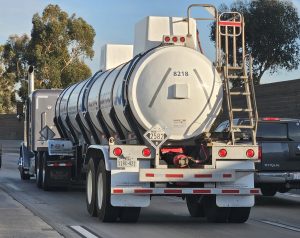
“Tank fleets need answers that reflect cargo containment, surge, axle loading, and emergency response—not just electric-truck adoption.”
Semi-trailer tank truck hauling ferric chloride with hazmat placard 2582. (Epolk / Wikimedia Commons, CC BY-SA 4.0)
This shift is especially important for propane, LPG, and other bulk-tank operations. Cargo tanks and propane service are among the clearest tank-industry hooks in the RFI. For tank trailer manufacturing, cargo tank design, and equipment-related coverage, explore the TankTrailers section and related Tankers updates.
What is new is the evidence that the market has already started asking builders how, or whether, such a configuration could be built and operated under today’s framework.
That does not prove near-term wide adoption. It does confirm that EV hazmat transport risks have become a real specification and compliance question for at least part of the cargo-tank industry.
What Is PHMSA Really Asking About EV Hazmat Transport Risks?
At bottom, PHMSA is asking whether the legacy hazmat rulebook assumes a diesel truck architecture in ways that no longer hold once batteries, high-voltage systems, different mass distribution, and charging infrastructure enter the picture.
The notice’s background section names four potential factor groups: battery hazards, charging-station vulnerabilities, weight distribution and cargo stability, and emergency-response adaptations.
It then asks for comparative evidence across seven categories, including packaging and containment, vehicle-specific safety and performance, infrastructure and charging, standards and compliance, emergency response, feasibility, and future research needs.
Propane and tank service remain central because the official public-facing notice specifically calls attention to hauling bulk hazmat such as propane in cargo tanks on EV chassis.
That is a crucial detail.
It means this is not only about box trailers carrying drums or packaged goods. It is also about permanently attached or portable bulk tanks, and therefore about rollover margins, slosh behavior, loading and unloading practices, hot-zone management, remote shutdown, and whether a battery event could expose or compromise a cargo tank in ways current standards did not contemplate. For more reporting on cargo tank safety, loading risks, inspection concerns, and tank-fleet operations, visit TankSafety coverage.
A less discussed but equally important part of the notice is its question about rescue documentation.
PHMSA explicitly asks whether emergency response guidance and rescue sheets based on ISO 17840 are sufficient for hazmat EVs and, if not, what additional information may be required.
That is not a minor clerical point.
It is the bridge between vehicle-level crash documentation and cargo-level dangerous-goods response. It suggests the agency is concerned not just with whether documents exist, but with whether they are detailed enough for mixed battery-and-cargo incidents.
Why Are EV Hazmat Transport Risks Now Broader Than Battery Fire Alone?
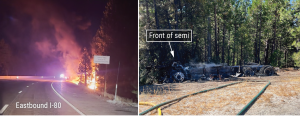
“A heavy-duty EV fire can become a long-duration emergency-response event before hazardous cargo is even added to the equation.”
Tesla Semi post-crash fire and final rest scene on I-80 near Emigrant Gap, California. (California Highway Patrol via NTSB)
The battery-fire question is real, but the latest evidence shows the issue is wider than flames alone.
The most relevant federal safety backdrop is the work of the National Transportation Safety Board, which found that high-voltage lithium-ion battery incidents create risks from electric shock, thermal runaway, reignition, and stranded energy remaining in a damaged pack.
The board also concluded that many manufacturer emergency guides historically lacked enough vehicle-specific detail on fire suppression, stranded-energy mitigation, and safe storage after an incident.
Those findings came from passenger-EV investigations, but the underlying response problems are directly relevant to heavy-duty operations. The same phenomena do not become easier when the vehicle is larger, the battery is bigger, and the cargo itself may be hazardous.
That last point is an inference, but it is a strong one.
There is, however, one important improvement since that NTSB work.
Under rules overseen by the National Highway Traffic Safety Administration, vehicles manufactured on or after December 22, 2025, are subject to documentation requirements for electric-powered vehicles, including rescue sheets and emergency response guides. For more federal vehicle-safety developments, review NHTSA coverage.
For heavy vehicles with a gross vehicle weight rating over 4,536 kilograms, rescue sheets must use ISO 17840-2. Emergency response guides must follow ISO 17840-3 and include information on fire, submersion, fluid leakage, towing, transportation, and storage.
That means the documentation baseline is better than it was when earlier EV responder debates began.
Still, a reasonable reading of the PHMSA docket is that standard vehicle-rescue documentation may not, by itself, resolve cargo-specific hazmat questions.
The clearest real-world proof point that these are not academic concerns is the ongoing 2024 Tesla Semi crash investigation.
In that case, the truck departed the roadway; its battery system ignited. Responders used about 50,000 gallons of water to extinguish and cool the batteries. Traffic lanes remained closed for roughly 14 to 15 hours, and the truck was then moved to an open-air facility and monitored for 24 hours. For additional reporting on battery-related vehicle incidents and fire-risk concerns, see ThermalEvent coverage.
No hazmat cargo was involved, but the operational burden was still substantial.
When PHMSA asks what changes if a similar battery event occurs while hazardous cargo is on board, that is not speculative. It is asking what happens when a known heavy-duty EV incident profile intersects with hazardous contents.
“A heavy-duty EV fire by itself can be complex. A heavy-duty EV fire involving a cargo tank, placarded load, or hazardous-material release would combine two emergency-response problem sets into one incident.”
How Do Charging, Tunnels, and Rescue Data Change EV Hazmat Transport Risks?
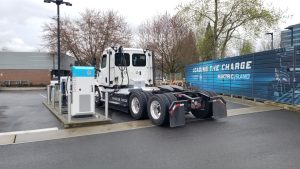
“For hazmat fleets, charging is not simply refueling with a plug; it introduces new questions about spacing, shutdown, spill control, and emergency access.”
Freightliner eCascadia 6×4 charging at a station. (Bill Beers / Wikimedia Commons, CC BY 4.0)
Charging is where progress and uncertainty now coexist.
On the progress side, SAE International published SAE J3271 for the Megawatt Charging System in March 2025, a meaningful step toward a common high-power charging architecture for heavy vehicles.
The Alternative Fuels Data Center says MCS is being developed to support charging up to 3.75 megawatts for medium- and heavy-duty applications. The federal government is also funding corridor-scale truck-charging demonstrations through the Department of Energy’s SuperTruck Charge initiative.
One of those projects includes a publicly accessible 10-plus-megawatt medium- and heavy-duty charging site in Barstow with MCS-compatible equipment.
On the uncertainty side, the infrastructure is not yet mature enough to make the charging question disappear for hazmat fleets. For developments in truck-charging infrastructure, freight corridors, and electrified fleet operations, visit ChargingStations coverage.
A 2025 analysis by the National Renewable Energy Laboratory reported that access to charging for freight lags behind light-duty EV access, and that 40 states had heavy-duty charging coverage below 10 percent in the study’s framework.
Another NREL review says most medium- and heavy-duty charging is still expected to happen at a home base or depot, with long-haul tractors and some regional-haul tractors needing en-route charging.
In plain English, that means a large share of commercial electric trucking remains easiest when the operator controls the site, dwell time, and routing.
Hazmat operations are often the opposite: time-sensitive, route-constrained, and sometimes dependent on where the next legally and operationally acceptable stop exists.
That tension is why PHMSA’s questions about tunnel fires, spacing between chargers, proximity to buildings, emergency shutdown, and charging-port location are smarter than they may first appear.
A charging standard can solve the connector interoperability.
It does not automatically solve hazmat-specific setbacks, spill-isolation procedures, shared-site exposure, or whether a placarded vehicle should be treated differently from a non-hazmat truck at public charging locations.
The agency seems to understand that distinction, and so should fleets.
How Do Weight, Cargo Tanks, and Routing Reshape EV Hazmat Transport Risks?
Weight distribution may turn out to be the most underappreciated part of this docket.
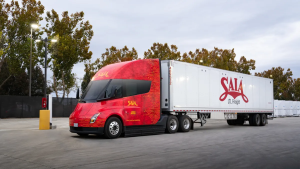
“The more capable electric tractors become, the more important it is to define where hazmat operations need additional safeguards.”
Saia’s Tesla Semi Truck Pilot. (Saia)
PHMSA’s notice specifically asks how EV battery weight affects load distribution, cargo stability, and packaging performance.
Federal law already gives natural-gas and electric vehicles some relief by allowing them to exceed the standard federal gross-vehicle weight limit by up to 2,000 pounds, up to a maximum of 82,000 pounds.
That helps, but it does not resolve every tanker-specific issue, because gross weight is only one part of the stability puzzle.
Center of gravity, axle loading, surge dynamics, rollover threshold, chassis integration, and braking behavior still matter.
The current product pages of major OEMs show how close this issue already is to the limit.
Freightliner’s eCascadia reaches a maximum gross combined weight of 82,000 pounds, and lists curb weights that rise with battery configuration.
Volvo’s VNR Electric advertises an 82,000-pound gross combined weight capability in a 6×2 tractor version, supported by an expanded six-battery system.
These are not minor spec-sheet details. They show the market is already configuring heavy battery-electric trucks right up against the federal weight relief that Congress created. For developments in battery-electric truck technology and zero-emission fleet technology, see BatteryElectric updates.
For dry van or drayage work, that may be manageable.
For bulk hazmat, especially tank applications with demanding loading geometry, it is a more sensitive engineering question. That conclusion is an inference from the specs and the nature of tank service, but it is well-grounded.
Routing reinforces the same point.
Freightliner’s current eCascadia range is 155, 220, or 230 miles, depending on configuration, while Volvo’s VNR Electric ranges up to 275 miles in certain six-battery setups.
Peterbilt’s 579EV update highlights up to 200 miles for regional-haul use, and Kenworth’s next-generation T680E is being marketed with around 200-plus miles of range.
Those are meaningful commercial capabilities, but they still fit best in predictable regional or local duty cycles.
A reasonable inference is that if EV hazmat transport risks shift from rulemaking debate to actual deployment, the first battleground will be shorter-haul or repeat-route applications rather than unrestricted long-haul tank service.
Which Company and Product Updates Matter Most to EV Hazmat Transport Risks?
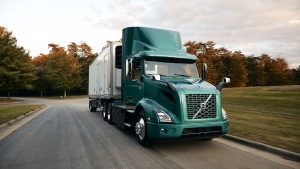
“Regional-haul electric trucks are moving from concept to fleet product, which makes the hazmat safety questions more immediate.”
Volvo VNR Electric Semi. (Volvo Trucks North America)
The most useful company update check is the current U.S. heavy-duty battery-electric field.
Tesla is the most visible headline platform.
Its current Semi page says deliveries start in 2026, the truck is 1.2-megawatt charge capable, and the company estimates 500 miles of range and 1.7 kilowatt-hours per mile energy consumption.
Tesla’s Q1 2026 update also says the Semi is on schedule for volume production in 2026.
That is a material update because it means PHMSA is studying EV hazmat transport risks as one of the most prominent long-range Class 8 electric trucks moves toward broader production.
Tesla also maintains a first-responder information portal and a semi-rescue sheet, which shows the company is at least building the required emergency-documentation layer.
Daimler Truck North America is relevant because the Freightliner eCascadia is no longer a conceptual vehicle.
Freightliner’s current page lists typical ranges of 155, 220, or 230 miles, says the truck can charge from zero to 80 percent in as little as 90 minutes, and posts an 82,000-pound maximum gross combined weight.
Daimler Truck North America also publicly hosts emergency response guides for its electric vehicles, including the eCascadia, which contain vehicle-specific shutdown and towing information.
For fleets, that means there is now a production-adjacent electric tractor with documented response procedures, but not yet a hazmat-specific operating framework attached to it. For more updates on electric heavy-duty truck platforms, follow ElectricTrucks reporting.
Volvo Trucks North America is arguably the most commercially grounded regional-haul example at the moment.
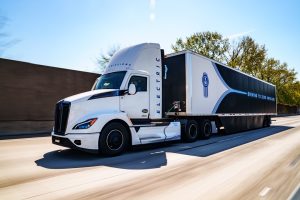
“As OEMs expand battery-electric Class 8 offerings, regulators are asking whether hazmat rules need to evolve with the equipment.”
Kenworth’s next-generation T680E battery-electric truck is shown in OEM launch imagery. (Kenworth)
Its VNR Electric page lists up to 275 miles of range in some configurations, an 82,000-pound gross combined weight rating for the 6×2 tractor, and fast-charge support via CCS1.
Volvo also provides an emergency response guide for its trucks and has continued to announce real-world VNR Electric deployments in 2026, including trucks for City Harvest in New York.
That makes Volvo important to this story because it shows the market is broadening in the exact regional-haul segments where battery-electric freight makes the most operational sense today.
PACCAR matters because it is refreshing both of its major U.S. brands in this segment.
Kenworth said in April 2025 that its next-generation T680E was available for order in the United States, while Peterbilt’s update on the 579EV emphasized regional-haul positioning, improved aerodynamics, and added active-safety features.
PACCAR’s January 2026 annual results also stated that Kenworth and Peterbilt introduced next-generation battery-electric trucks.
That does not mean a hazmat-ready battery-electric tanker spec has arrived.
It does mean the competitive set is deepening, which raises the odds that regulators will see real carrier experimentation before long.
What Should Fleets Tell Regulators About EV Hazmat Transport Risks Now?
The most valuable comments to regulators will not be ideological. They will be scenario-based.
PHMSA has already told the market what it needs: evidence of battery heat exposure to packages and cargo tanks, charging-site risk management, weight-and-stability effects, emergency response, and the remaining training or documentation gaps.
The best industry submissions will therefore focus on concrete use cases.
Those could include a battery event near an MC-331 or similar bulk tank, an EV tractor connected to a charger during loading or unloading, a tunnel or enclosed-terminal incident, tow-yard monitoring after a crash, and whether certain hazardous classes should be treated differently during the early years of electric deployment.
The second priority is documentation that bridges vehicle rescue and cargo response.
Thanks to post-2025 NHTSA rules, standardized rescue sheets and emergency response guides now exist in a more formal framework than before.
But the NTSB’s earlier work on stranded energy, reignition, and guide limitations remains highly relevant, and PHMSA’s own notice shows the agency still doubts that general EV response material automatically answers hazmat-specific questions. For safety issues affecting motor carriers, drivers, equipment, and fleet operations, browse FleetSafety coverage.
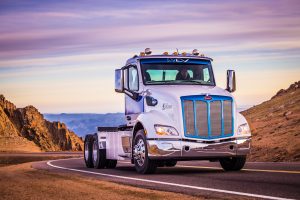
“Most current Class 8 electric platforms point toward regional, repeat-route duty cycles—the same operating environment where early hazmat questions may surface first.”
Peterbilt Model 579EVs. (Peterbilt)
Fleets, builders, and responders should therefore push for documentation that integrates battery state, cargo class, shutdown steps, isolation distances, tow and storage rules, and recommended badging into one operational picture.
The regulatory concern remains directionally clear, but the new evidence sharpens its practical stakes.
EV hazmat transport risks are no longer just about whether battery fires behave differently from diesel fires.
They now sit at the intersection of cargo-tank engineering, public charging availability, first-responder information, tow-and-storage risk, and the still-limited but quickly expanding Class 8 electric product market.
As of May 4, 2026, PHMSA has not issued a new rule, a new hazmat restriction, or a new special permission pathway for routine electric hazmat hauling. The agency is still asking the market to help define where the real safety gaps are, and the comment period closes today.
Open questions remain.
Comments received after May 4 may still be considered to the extent possible, according to the Federal Register notice, but today is the formal deadline for timely submissions.
Among the official product pages and company releases reviewed here, manufacturers describe regional-haul, drayage, local delivery, and fleet-decarbonization use cases. Still, none publicly markets a purpose-built hazmat battery-electric cargo-tank platform.
That absence does not prove that such a platform cannot emerge.
It does explain why the current federal conversation is still centered on EV hazmat transport risks, not yet on an accepted national operating template for electric hazmat fleets.
Key Developments in EV Hazmat Transport Risks
- PHMSA’s comment deadline closes May 4, 2026, making the heavy-duty EV hazmat RFI a live federal issue for tank fleets and hazardous-materials carriers.
- The agency is not proposing a rule yet, but it may use industry feedback to guide future research into battery-electric hazmat transportation risks.
- Cargo tanks are directly in scope, including PHMSA’s reference to bulk hazardous materials such as propane carried in cargo tanks on EV chassis.
- Battery fire behavior remains a central concern, especially thermal runaway, stranded energy, reignition risk, and toxic or flammable gas emissions.
- Charging infrastructure creates new operational questions, including charger setbacks, emergency shutdown procedures, tunnel incidents, and whether placarded vehicles need different site rules.
- Weight distribution and cargo stability are major tank-fleet issues, since heavy battery-electric tractors can affect payload, axle loading, handling, braking, and rollover margins.
- Emergency response documentation is improving, with standardized rescue sheets and emergency response guides now required for covered electric vehicles manufactured after December 2025.
- Class 8 electric truck products continue advancing, with Tesla, Freightliner, Volvo, Kenworth, and Peterbilt all positioning battery-electric tractors for regional, drayage, or fleet applications.
- No major OEM appears to be publicly marketing a purpose-built hazmat electric cargo-tank platform, keeping the regulatory discussion focused on unresolved EV hazmat transport risks rather than a settled operating model.
Resources on EV Hazmat Transport Risks
- Review PHMSA’s official request for information on heavy-duty electric vehicles and hazardous-materials transportation at PHMSA’s EV hazmat transport notice.
- Read the published Federal Register notice for the full docket language, comment deadline, and agency questions at Federal Register Document 2026-01989.
- Access the printable federal notice and official PDF record through GovInfo’s PHMSA RFI document.
- Check the public docket and related filings for PHMSA-2025-0678 at Regulations.gov’s PHMSA-2025-0678 docket.
- Review federal requirements for electric-vehicle rescue sheets and emergency response guides at 49 CFR § 561.6 in the eCFR.
- Learn how NHTSA structures documentation requirements for electric-powered vehicles at 49 CFR Part 561.
- Review the NTSB’s preliminary investigation of the Tesla Semi roadway departure and post-crash battery fire at NTSB Investigation HWY24FH015.
- Explore the NTSB safety report on electric-vehicle battery fires, stranded energy, reignition risk, and emergency-response challenges at NTSB Safety Report SR-20/01.
- Find technical background on SAE’s Megawatt Charging System information report at SAE J3271 Megawatt Charging System.
- Understand charging infrastructure, DC fast charging, and MCS development for medium- and heavy-duty vehicles at DOE’s Alternative Fuels Data Center charging resource.
- Review federal weight-exemption guidance for electric and natural-gas vehicles at AFDC’s NGV and EV weight exemption summary.
- Read about DOE funding for heavy-duty electric vehicle charging demonstrations through SuperTruck Charge at DOE’s SuperTruck Charge announcement.
- Explore NREL’s research on high-power medium- and heavy-duty EV charging at NREL’s medium- and heavy-duty vehicle charging program.
- Review Tesla’s current specifications and production timing for its battery-electric Class 8 platform at Tesla Semi.
- See Freightliner’s published range, charging, and gross-combination-weight information for its electric Class 8 tractor at Freightliner eCascadia.
- Review Volvo Trucks’ regional-haul battery-electric truck specifications at Volvo VNR Electric.
- Explore Kenworth’s next-generation battery-electric Class 8 platform at Kenworth T680E.
- Review Peterbilt’s regional-haul and drayage specifications for its Class 8 electric tractor at Peterbilt Model 579EV.